
Angular measurements play a huge role in long range shooting. When adjusting for increased distances or compensating for wind, the barrel is pointed at an angle from the target to compensate for bullet deflection down range. The two main angular measurement systems used are either degrees or radians, but since hold angles for shooting are relatively small, they are broken down into smaller segments that we call MIL’s (milliradians) or MOA (Minute of angle).
What is a minute of angle?
We’ll start with MOA since this is the unit that most shooters in the US have started with, and for good reason that we’ll get to later. We’re all familiar with angles and circles, and how there are 360 degrees within an entire circle. But when shooting and holding offsets, almost all rifles never use more than a full degree of offset when shooting at reasonable distances for that cartridge (excluding extreme long range shooting). Because of this the degree is broken up into smaller increments. For a reason I don’t know, degrees are broken up into minutes and seconds, just like time. In one degree there are 60 minutes, and there are 60 seconds in each minute, or 3600 seconds in a degree. Why they are broken up like this, I have no idea, but this is where MINUTE of angle comes from. 1 minute of angle is 1/60th of a degree. For math purposes and the trigonometry you might remember from high school, this really isn’t a great measurement system but it has one huge perk in America. Out of essentially sheer luck from the way our units work, 1 MOA at 100 yards is almost exactly 1”. Technically it’s 1.047” but it’s close enough that 1” can be used without significant error. And since it’s angular, it carries nicely to different shooting distances, 1 MOA is 2” at 200 yards, 6” at 600 yards and so on. By the time you reach 1000 yards, 1 MOA is 10.47”, an almost 5% error from the 10” estimation. When adjusting holdover, that 5% error is essentially imperceivable and I don’t know of anyone that can consistently hold on target .5” at 1000 yards. When using angles and target size to calculate distance the 1” per 100 yard assumption can lead to some range estimation error, but that’s a lesson for another day.
What is a milliradian?
Now into MIL’s. Radians are something people don’t generally have a good concept of unless you failed a math test because your calculator was set to radians instead of degrees. Just like degrees, Radians are a way to break up components of a circle, but they are much more math and calculation friendly. Instead of 360 degrees in a circle, there are 2π(pi) radians in a circle. Now this seems like a weird system to pick (since π=3.14159…repeating forever) but there is a very good reason it was done this way. Back to high school math, the circumference of a circle is π*diameter(d). Since the diameter is 2*radius(r), the circumference of a circle is 2πr. So, the circumference of a circle is the radius times 2π(radians). I’ll skip the calculus proof, but this also applies to arcs and not just full circles. The arc length equals the radius time the angle in radians, so 1 radian is the angle where the arc length equals the radius. This is true for any value of a radius, and the angle is roughly 57.3 degrees. Degrees and radians are both measurements of the same thing, so they can be converted back and forth, radians are just set up to make math and calculations work. Now, since a radian is so large it is also broken up into more manageable units called milliradian. For users of the metric system this makes sense, milli is 1/1000th and a milliradian is 1/1000th or a radian, or .001 radians. Since the arc length equals the radius time the angle in radians, r * .001 radians the arc length equals radius/1000. So, 1 MIL at 1000 yards is 1 yard. Next, let’s see how angles and circles apply to what we need to know for shooting.
Here is 1 radian in a circle.

Here is 1 MIL within a radian, as you can see it is relatively very small.

Why are we looking at circles?
At this point you might be wondering what circles have to do with any of this. It seems more like a triangular measurement and you probably remember trying to memorize SOH CAH TOA in math class, while wondering what the hell a SIN COS and TAN was. You’re not wrong, but we can use some approximations that make using circles much easier than trying to use trig functions. In the image below, we compare the triangular measurements vs those of a circle. At 1 radian, the arc length is 100 but the triangular height is almost 156. That’s over 50% error and isn’t very useful, but the smaller the angle gets, the less error there is. At .5 radians (500 MIL’s) the error is 10%, and at .1 radians (100 MIL’s) the error is down to 0.3%. This error continually goes down the smaller the angle gets. When looking at a very small portion or a circle or curve, the arc can be approximated as a straight line. This is where flat earthers come from.
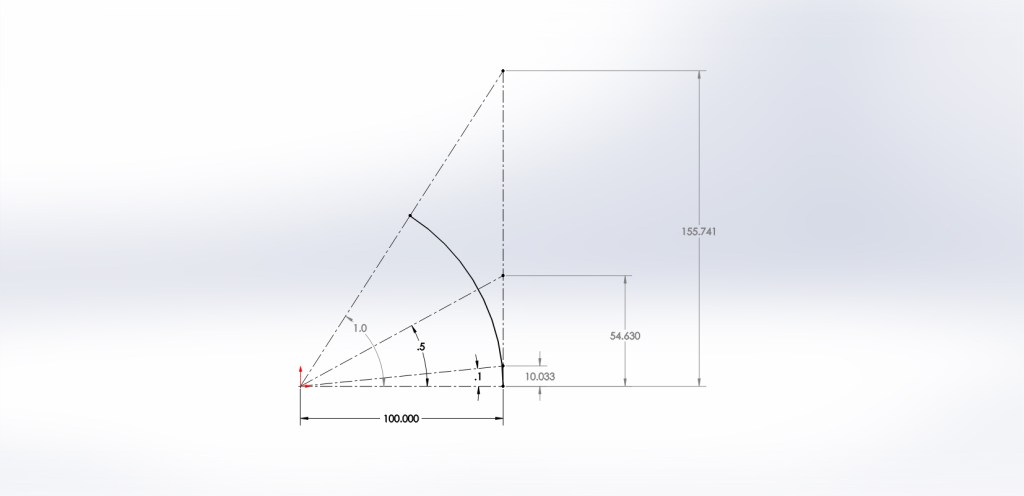
Since the arc measurements are essentially the same as the triangular measurements, we don’t have to use the sine cosine and tangent functions. We can use the much easier arc length measurements that we looked at earlier, where the arc length equals the radius times the angle in radians.
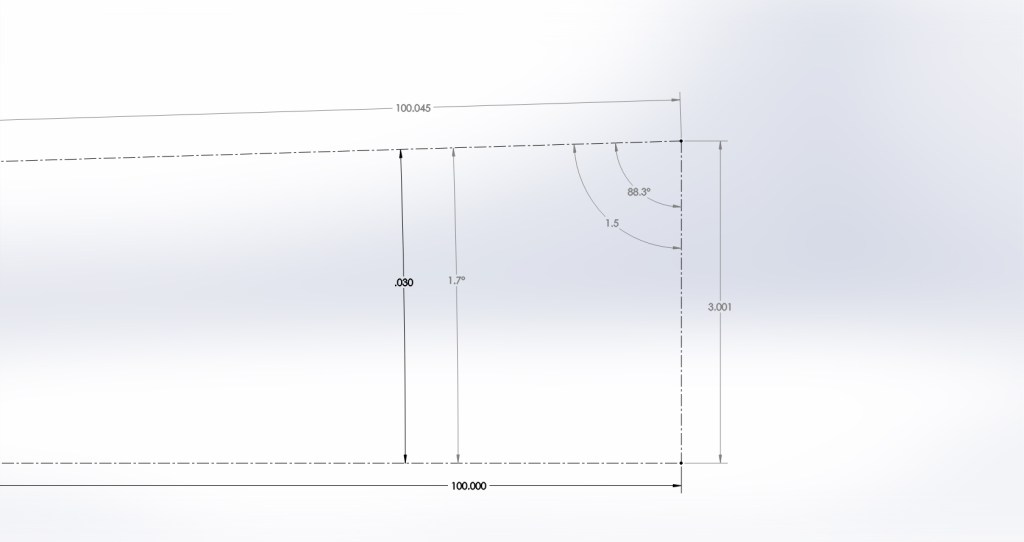
Here is one more image showing a zoomed in comparison with an angle of 30 MILS or .03 radians. At this point the vertical error assuming an arc length of 3 (100 * .03 radians) is .03%. for the comparison, 30 MIL’s equals 1.7 degrees or 102 MOA.
Relating this back to Shooting.
Now that we understand what these units are, let’s bring this back to use in shooting. When adjusting the riflescope to align with the point of impact or holding for bullet drift, we are pointing the muzzle away from the target at an angle from our target line of sight. If we hit 5” to the right, we don’t pick up and move the gun 5” while keeping the shooting angle the same, we leave the rifle in the same spot and just shoot at a slightly different angle to the target to compensate for the difference. Instead of using this article to dive into rifle scopes and make this extremely long, I will leave that for another day. But generally scope manufacturers set the adjustments in the scope turrets to either .25 MOA per click (~.25 at 100 yards) or .1 MIL’s (.36” at 100 yards) depending on what measurement system the particular scope uses.
Which one to Use?
We have now defined what the two systems are, how they work, and what they mean, so which one do I use? There are pros and cons to both so let’s look at those.
MOA:
As I mentioned earlier, for us in America where 1 MOA roughly equals 1” at 100 yards, the measurements become very simple. We are used to using inches to measure and yards for shooting distances. The downsides come when we convert units. Since distance is in yards and we adjust in inches, any measurements we do with the reticle has to be converted to the same units. Looking at the earlier example showing the 1.7 degrees (102 MOA) at a distance of 100, the height is 3. But 3 What? If 100 yards, then the height is 3 yards, but we have to convert that back to inches. 12 inches per foot, and 3 feet per yard gives us 108 inches. So if we have to do measurements or conversions MOA starts to get a little tough by having to use conversion factors to change units.
And if using meters and MOA, things get even worse. At 100 meters, 1 MOA is .029 meters (2.9 centimeters). That doesn’t do much good. MOA has a place for very simple measurements for those of us familiar with inches and yards. But beyond that it can get difficult.
MIL’s:
Now with MIL’s, we’ve seen that the math works out nicely, but it does have a downside for us using inches. It has to do with conversion factors again. Since 1 MIL is just 1/1000th the distance, at 1000 yards a MIL is just 1 yard. Pretty simple, but no one is going to say, “Hold 1 yard higher”. We then must convert back to inches. 1 MIL at 1000 yards is 36”, and at 100 yards it is .1 yards or 3.6 inches. Using the metric system makes this much easier. 1 MIL at 1000 meters is 1 meter, or 100 centimeters, or 1000 millimeters. The base units break down much nicer when doing conversions. At 100 meters, 1 MIL is 10 centimeters, or 100 millimeters. To people used to that system, it makes sense. At a distance of 434 meters, 1 MIL is 43.4 centimeters or 434 millimeters. It makes ranging targets of a known size and angle much easier. If something is 500 centimeters tall and measures 1 MIL, then the distance is 500 meters. Again, we’ll look at the equations for distance measuring in a different article.
I can’t tell you which system will be right for you, but there is the basics. If you always shoot at known distances and are used to inches, the MOA probably makes sense. If you are familiar with metric or want to use angular measurements, MIL’s is typically simpler. If shooting with a group, it does help if everyone is running the same units. If 5 guys are running MOA but 1 is running MIL’s, it will be much harder to call shots and corrections for the odd man out. These are all things to consider, but just know that most competitive shooters are trending towards MIL’s if that is something you are considering doing.




 LONG RANGE SCIENCE
Leave a comment