
Whether buying bullets for reloading, or loaded factory ammo, one thing usually listed is the ballistic coefficient (BC) of the bullet. This is usually either listed as a G1 or G7 BC and sometimes both. So what do these numbers actually mean? Let’s dive in and break this down a little.
The first thing to know about the “G” ballistic coefficients is that they are a comparison to a standard. There are other G ballistic coefficients, such as G2, G4, etc…, and each one is in reference to a particular shape of projectile. These are pre determined standards that projectiles of a similar shape are compared to. The G1 projectile is based off of old style flat base bullets with rounded noses, while the G7 is based on the modern low drag style boat tail bullets. Because it is a comparison, you want to pick the G factor that most closely matches your bullet for accurate information.
Now, how does BC actually relate to projectile flight since it is a comparison? The equation used in the industry is

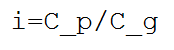
where m is the mass, d is the diameter, and i is the form factor. C_p is the projectile drag coefficient, and C_g is the G standard drag coefficient. The form factor is where the comparison to the standard comes into play. The form factor is defined as the drag coefficient of the projectile divided by the drag coefficient of the G standard. This means that each G series has its own form factor. A from factor of 1.0 means that the projectile has the same drag coefficient as the standard, where a form factor of .9 means there is less drag than the standard. Because these measurements are based on the drag of the bullets, the ammunition manufacturer will provide those values because of the specialized equipment needed to actually measure those values.
Since BC is a comparison of drag factors, lets dive into what drag factor means. below is the typical equaiton

where


F_d is the force of drag, and A is the cross sectional area
knowing the drag coefficient allows us to rearrange the equation and solve for F_d.
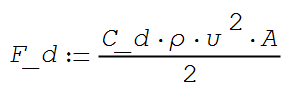
now, since force equal mass time acceleration we can calculate how fast the bullet is slowing down. A lower drag coefficient leads to a lower drag force.
Lets tie this back to BC. the drag coefficient of the G series standard is already defined so the BC is a comparison to that standard. A higher BC corresponds to a lower drag coefficient, and therefore less drag force.
Now the question comes back to which one, G1 or G7, is more accurate. If using modern low drag bullets the G7 shape is going to be much closer. That is why the G1 BC is typically larger, because long range bullets are much more aerodynamic that the G1 standard. This leads to a more drastic difference if drag coefficient and much smaller form factor, so a larger BC. For the G7, the profiles are similar so the difference between the two drag factors isn’t as great. It’s a much more consistent comparison, but that results in a lower BC number. This is where marketing comes into play. Because a larger BC means better down range ballistics, most bullet manufacturers advertise the G1 BC because it is larger and looks better. Even though it may not be the most accurate. G7 is starting to become more popular as most bullets now more closely match the G7 profile. Most ballistic calculators will allow you to use either the G1 or G7 of the projectile.
One interesting aspect of this is that because drag is a function of the projectiles velocity, it is constantly changing as the speed changes. This means that the drag force, and therefore the BC, is constantly changing. This is another reason why using the correct BC is important, because the further down range you go, the less accurate the wrong G standard will be. This is also why the BC printed on the box is an average BC for a velocity range. Some companies, such as Sierra bullets, actually provide multiple BC’s for various velocity ranges.




 LONG RANGE SCIENCE
Leave a comment